
Built-in cylinders
CAD data
Built-in cylinder Type 210 ∣ CAD
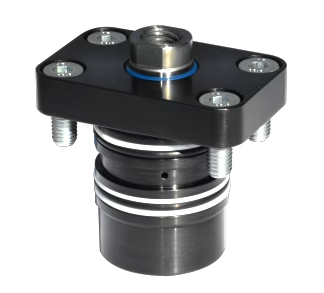
Piston rod: with internal thread
Seal variant: NBR
- Stroke – 16mm: 210-016-016.step
- Stroke – 50mm: 210-016-050.step
Piston rod: with internal thread
Seal variant: FKM
- Stroke – 16mm: 210-016-016-V.step
- Stroke – 50mm: 210-016-050-V.step
Piston rod: with external thread
Seal variant: NBR
- Stroke – 16mm: 210-016-016-A.step
- Stroke – 50mm: 210-016-050-A.step
Piston rod: with external thread
Seal variant: FKM
- Stroke – 16mm: 210-016-016-V-A.step
- Stroke – 50mm: 210-016-050-V-A.step
Piston rod: with internal thread
Seal variant: NBR
- Stroke – 20mm: 210-025-020.step
- Stroke – 50mm: 210-025-050.step
Piston rod: with internal thread
Seal variant: FKM
- Stroke – 20mm: 210-025-020-V.step
- Stroke – 50mm: 210-025-050-V.step
Piston rod: with external thread
Seal variant: NBR
- Stroke – 20mm: 210-025-020-A.step
- Stroke – 50mm: 210-025-050-A.step
Piston rod: with external thread
Seal variant: FKM
- Stroke – 20mm: 210-025-020-V-A.step
- Stroke – 50mm: 210-025-050-V-A.step
Piston rod: with internal thread
Seal variant: NBR
- Stroke – 25mm: 210-032-025.step
- Stroke – 50mm: 210-032-050.step
Piston rod: with internal thread
Seal variant: FKM
- Stroke – 25mm: 210-032-025-V.step
- Stroke – 50mm: 210-032-050-V.step
Piston rod: with external thread
Seal variant: NBR
- Stroke – 25mm: 210-032-025-A.step
- Stroke – 50mm: 210-032-050-A.step
Piston rod: with external thread
Seal variant: FKM
- Stroke – 25mm: 210-032-025-V-A.step
- Stroke – 50mm: 210-032-050-V-A.step
Piston rod: with internal thread
Seal variant: NBR
- Stroke – 25mm: 210-040-025.step
- Stroke – 50mm: 210-040-050.step
Piston rod: with internal thread
Seal variant: FKM
- Stroke – 25mm: 210-040-025-V.step
- Stroke – 50mm: 210-040-050-V.step
Piston rod: with external thread
Seal variant: NBR
- Stroke – 25mm: 210-040-025-A.step
- Stroke – 50mm: 210-040-050-A.step
Piston rod: with external thread
Seal variant: FKM
- Stroke – 25mm: 210-040-025-V-A.step
- Stroke – 50mm: 210-040-050-V-A.step
Piston rod: with internal thread
Seal variant: NBR
- Stroke – 25mm: 210-050-025.step
- Stroke – 50mm: 210-050-050.step
Piston rod: with internal thread
Seal variant: FKM
- Stroke – 25mm: 210-050-025-V.step
- Stroke – 50mm: 210-050-050-V.step
Piston rod: with external thread
Seal variant: NBR
- Stroke – 25mm: 210-050-025-A.step
- Stroke – 50mm: 210-050-050-A.step
Piston rod: with external thread
Seal variant: FKM
- Stroke – 25mm: 210-050-025-V-A.step
- Stroke – 50mm: 210-050-050-V-A.step
Piston rod: with internal thread
Seal variant: NBR
- Stroke – 30mm: 210-063-030.step
- Stroke – 63mm: 210-063-063.step
Piston rod: with internal thread
Seal variant: FKM
- Stroke – 30mm: 210-063-030-V.step
- Stroke – 63mm: 210-063-063-V.step
Piston rod: with external thread
Seal variant: NBR
- Stroke – 30mm: 210-063-030-A.step
- Stroke – 63mm: 210-063-063-A.step
Piston rod: with external thread
Seal variant: FKM
- Stroke – 30mm: 210-063-030-V-A.step
- Stroke – 63mm: 210-063-063-V-A.step
Technical information
Safety note
Operating pressure
Seals
Installation position
Pressure fluids
Transverse forces
Travel speed
Stroke lengths
Application
Einbauzylinder ∣ FAQ
Ein Einbauzylinder ist ein Zylinder, der speziell für den Einbau in eine Bohrung entwickelt wurde. Im Gegensatz zu herkömmlichen Zylindern, wird ein Einbauzylinder in eine Bohrung eingebracht und mittels 4 Schrauben am Flansch befestigt. Dabei kann der Flansch entweder überstehen (aufgesetzte Montage) oder vollständig in das Werkzeug/die Vorrichtung eingelassen werden (versenkte Montage), wodurch er bündig mit der umgebenden Oberfläche abschließt.
Der Aufbau eines Einbauzylinders ist ähnlich wie bei anderen Zylinderarten. Er besteht aus einem Gehäuse, einem Kolben, Dichtungen und Zuführbohrungen für die Hydraulikflüssigkeit. Der Zylinderkörper des Einbauzylinders wird in eine zu erstellende Passbohrung eingebracht und am Flansch verschraubt.
Der Vorteil eines Einbauzylinders liegt in seiner Integrationsfähigkeit in die umgebende Struktur (Vorrichtung/Werkzeug), was eine kompakte Montage ermöglicht. Die Einbaubohrung ist einfach zu erstellen und bei einer versenkten Montage ergibt sich ein ebener Abschluss zwischen Zylinder und Vorrichtungs-/ Werkzeugkörper.
Einbauzylinder finden in einer Vielzahl von Anwendungen Verwendung, insbesondere dort, wo eine ebene Oberfläche oder eine nahtlose Integration erforderlich ist. Einige typische Anwendungsgebiete von Einbauzylindern sind:
- Maschinenbau
- Fertigungstechnik
- Vorrichtungsbau
- Formenbau
- Anlagenbau
- Robotik
- Automatisierungstechnik
- Handhabungstechnik
Diese Anwendungen sind nur einige Beispiele, und die Verwendung von Einbauzylindern kann je nach spezifischer Anwendung und Industrie variieren. Insgesamt bieten sie eine effiziente und zuverlässige Lösung für die Realisierung linearer Bewegungen in einer Vielzahl von Anwendungen.
Die Materialien, die typischerweise für die Herstellung von Einbauzylindern verwendet werden, hängen von den spezifischen Anforderungen der Anwendung, den Betriebsbedingungen und den mechanischen Eigenschaften ab, die der Zylinder erfüllen muss. Einige typische Materialien sind:
- Stahl
- Edelstahl
- Aluminium
Einbauzylinder unterscheiden sich von anderen Zylinderarten in verschiedenen Aspekten, darunter ihre Befestigungsmethode, ihre Einbauart und ihre Integrationsfähigkeit. Einige Hauptunterschiede zu anderen Zylinderarten sind:
Befestigungsmethode: Einbauzylinder werden direkt in eine Bohrung oder eine Passung eingebaut. Befestigt werden Sie mittels vier Schrauben am Zylinderflansch.
Einbauart: Einbauzylinder sind speziell für den Einbau in eine Passbohrung entwickelt worden. Sie sind oft kompakter als herkömmliche Zylinder.
Integration in die Struktur: Einbauzylinder werden direkt in die umgebende Struktur integriert. Dabei können sie einerseits so montiert werden, dass der Flansch direkt an der Oberseite übersteht (aufgesetzte Montage), oder der Zylinder wird direkt bündig in den Vorrichtungskörper eingebracht (versenkte Montage).
Einsatz in begrenzten Einbauräumenäumen: Einbauzylinder sind besonders nützlich in Anwendungen, wo begrenzter Platz vorhanden ist oder wo viele Zylinder auf kleinem Raum sehr nahe nebeneinander eingesetzt werden müssen (Bspw. Spannvorrichtungen).
Hydraulic built-in cylinders from Germa GmbH – innovative, double-acting cylinders, specially for fixture construction, tool making and mold making as well as general mechanical engineering
With 6 available sizes and two stroke variants, series 210 offers a wide selection of cylinders to meet customer-specific requirements. The cylinders are also optionally available with internal or external thread on the piston rod. The option of NBR or FKM seals ensures application-oriented and durable sealing.
The installation of the built-in cylinder is straightforward: The cylinder is inserted directly into the fixture or tool and fastened at the head flange using the supplied screws. The installation bore is easy to create. This convenient mounting method simplifies integration and ensures reliable fixing. Furthermore, the bore for the forward stroke can be positioned very flexibly in the fixture or tool.
The hydraulic built-in cylinder “type 210” also focuses on maximum efficiency in multiple clamping. Due to the innovative mounting method at the head flange, combined with the possibility of line-free pressure oil supply, the built-in cylinder becomes the optimal solution for applications with complex clamping situations.
For fixture construction, tool making and mold making as well as general mechanical engineering, the built-in cylinder of series 210 is the ideal choice. Its adaptability and innovative mounting method offer maximum efficiency and precision in your application.